Sternwood estate
The Big SleepSternwood estate is the family home of General Guy Sternwood and his daughters, Vivian Regan and Carmen Sternwood. Its landscaped terraces and imposing interior give material form to inherited wealth and guarded privacy, while its views and repeated appearances connect the family’s sheltered life to the oilfield beneath the hill and to the crimes Marlowe investigates beyond the estate. The place frames the investigation at both ends: Marlowe first enters it as a hired detective and returns near the close to speak with the dying General and confront Carmen.
Setting and Appearance
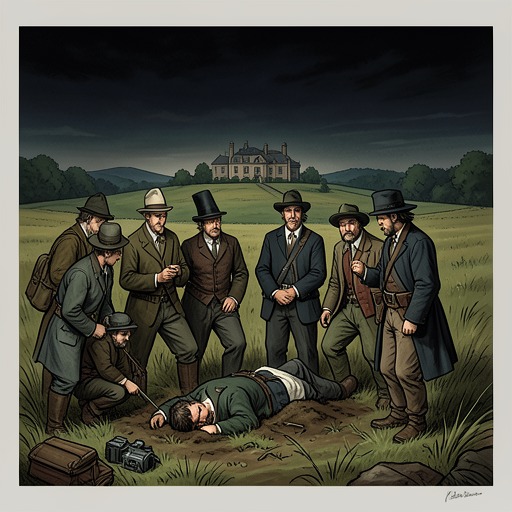
The estate rises above the city on a hillside. From its main hall, French doors open toward emerald lawns and a white garage, with a maroon Packard convertible and a chauffeur among the signs of the household’s resources. Beyond the garage, clipped ornamental trees and a domed greenhouse lead the eye toward the foothills. The carefully tended grounds contrast with the older, less controlled landscape below.
Inside, the main hall is two stories high, with a gallery and a staircase paved in tile. Large, formal chairs occupy spaces around the walls, while a marble mantel, an officer’s portrait, and old cavalry pennants establish a lineage older than the living household. Above the entrance, a stained-glass panel shows a knight beside a bound woman; Marlowe notices that the knight appears unable to free her. The image becomes a recurring visual detail of the house: on his return, the knight is still not getting anywhere.
The architecture communicates distance as much as grandeur. The hall’s height, its largely unused furniture, and the long approach through terraces distinguish the family’s private world from the streets below. On Marlowe’s final visit, the General’s bedroom lies beyond an enormous old door and across what seems to be a quarter of a mile of carpet. The room’s great canopied bed and the General’s frail appearance make the scale of the house a measure of the distance separating the family from ordinary life.
Wealth, Landscape, and Boundaries
The estate’s position makes its economic history visible. From the steps outside, Marlowe sees a succession of terraces, flowerbeds, trimmed trees, and a high iron fence topped with gilt spears. Beyond the gates, the hill descends toward the old oilfield from which the Sternwoods made their money. Most of the field has become public parkland, cleaned up and donated to the city by General Sternwood, but a small part still produces oil. The family has moved uphill, away from the smell of the wells, yet the remains of the source of its fortune can still be seen from the house.
That view complicates the estate’s polished seclusion. Its gardens and carefully managed approaches seem to separate the family from the city, but the property’s wealth remains rooted in the industrial ground below. At the close, the contrast sharpens when Carmen takes Marlowe to the abandoned oilfield, where the road passes a rusted derrick, unused equipment, and an old sump. The neglected site stands in stark relation to the green terraces above it: both belong to the same family history, but they display sharply different faces of it.
The estate’s boundaries also shape who may enter and what can be seen. Its terraces descend toward a tall metal railing and gated exit; the grounds are presented as open to the household but closed off from the public world. On one visit, Norris refuses Marlowe access to Vivian, politely acknowledging his mistake while shutting the door. The incident makes the house’s hospitality conditional: even a detective working for the family can be kept outside a particular room or conversation.
The Estate in the Investigation
The house is the setting of Marlowe’s initial commission. He arrives in the morning, dressed as a professional detective, to call on the family’s fortune and meet the General. The formality of the hall and its inherited decorations establish the class setting of the case before the investigation moves into bookstores, private rooms, and the rain-darkened streets of Los Angeles. The estate is not where the early murders occur, but it is the source of Marlowe’s employment and the reason he must handle their consequences with care.
The family’s connection to the crimes becomes a matter of official and private negotiation. Bernie Ohls tells Captain Cronjager that the dead chauffeur from the car recovered off Lido Pier worked for a wealthy family being blackmailed over one of its daughters; Marlowe had been recommended to that family through Taggart Wilde. When Marlowe recounts his investigation, he leaves out Carmen’s visit to Joe Brody’s apartment and Eddie Mars’s visit to Arthur Geiger’s house. He later argues that Geiger’s bookstore was a front for illicit activity and that police protection had allowed it to operate. The estate therefore remains present in the case even when absent from its crime scenes: the family’s wealth and vulnerability influence what Marlowe reports and what the authorities are willing to make public.
The published account of the murders further separates the family home from the public story. The newspapers identify Owen Taylor only as a chauffeur to a wealthy family and omit the Sternwoods, Ohls, and Marlowe. The official version instead credits Cronjager with solving the killings and presents them as a dispute involving a wire service. The contrast between the secluded estate and the sanitized public account shows how privacy can be maintained not only by gates and rooms but also by the selective handling of information.
Return and Narrative Significance
Five days after his first visit, Marlowe returns to the estate. The weather has cleared; the lawns are green, the birds are singing, and the main hall appears unchanged. That continuity is unsettled by what he now knows. He carries Carmen’s pearl-handled revolver and goes to see the General, whose gray hands lie clasped on the sheet and whose face still looks corpse-like despite the fight remaining in his eyes. The house’s scale and quiet give their meeting a ceremonial weight, but the General’s physical decline makes clear how little protection wealth can offer against mortality.
After speaking with the General, Marlowe sees Carmen alone on a stone bench among the terraces, her head in her hands. He takes her away from the estate, and she directs him to the old oilfield. The movement from the ordered gardens down toward the disused wells leads the investigation from the family’s visible respectability to the place where the novel’s buried truth is confronted. When Marlowe leaves the estate again, its bright gardens seem haunted to him; the familiar setting has acquired the weight of what he knows and has chosen not to expose.
The estate thus functions as more than a wealthy backdrop. Its elevation, controlled access, and carefully maintained appearance express the family’s power to withdraw from public scrutiny, while the oilfield below preserves the material history beneath that appearance. Its repeated images—the stained-glass knight, the distant wells, the long approach to the General’s room—bind together the novel’s concerns with inherited wealth, concealment, and helplessness. The house can shelter its occupants and shape the story told about them, but it cannot erase the violence or the knowledge that gathers within its boundaries.